Outreachy

Metadata
- Online presence:
- Based in: United States
- Years of activity: 2006, 20101-Present
Classification
- Structure model: Formal and rigid
- Compensation model: Financially supported
- Support model: Transient
- Disciplinary model: Interdisciplinary
- Mentorship model: One-to-one, many-to-one encouraged, hierarchical
- Instrumental model: Project-oriented
- Modality: Online
Overview
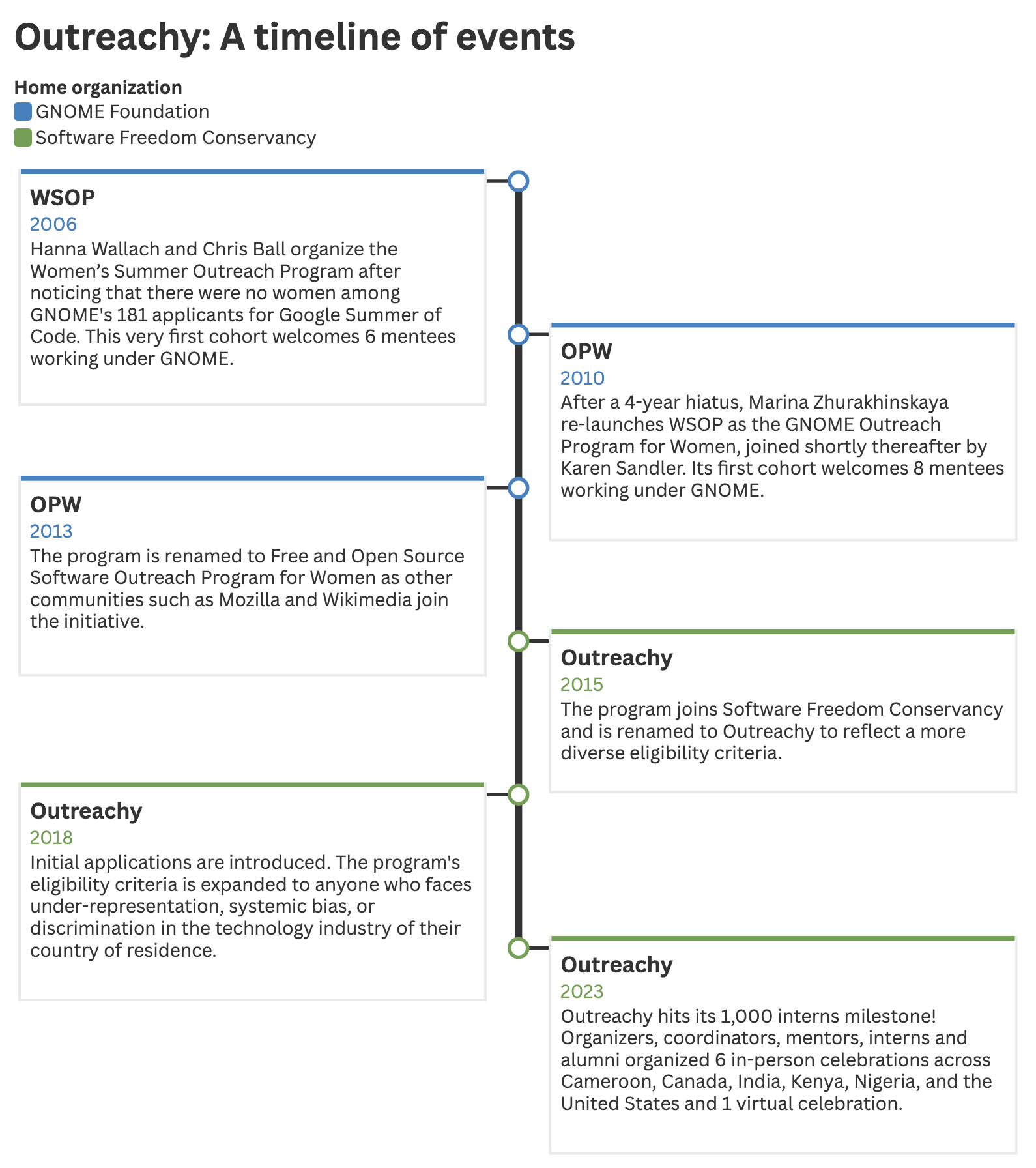
Outreachy is a Software Freedom Conservancy initiative that offers three-month internships in free and open source to anyone from any background who faces underrepresentation, systemic bias, or discrimination in the technical industry where they are living. The seeds of Outreachy were planted by Hanna Wallach and Chris Ball after they noticed no women among almost 200 applicants in the 2006 season of Google Summer of Code; the GNOME's Women's Summer Outreach Program (WSOP) encouraged women who were student developers to contribute to the GNOME desktop environment.
The initiative was later reactivated in 2010 as GNOME Outreach Program for Women under the GNOME Foundation by Marina Zhurakhinskaya, joined shortly thereafter by Karen Sandler. As other free and open source communities such as Mozilla and Wikimedia joined the program, it was renamed to the Free and Open Source Software Outreach Program for Women in 2013.
Under Software Freedom Conservancy, the program was renamed once more to Outreachy in 2015 to reflect changes in applicant eligibility. In addition to being open to women, trans men, and genderqueer people internationally, its eligibility criteria included residents and nationals of the United States of any gender who are Black/African American, Hispanic/Latin@, American Indian, Alaska Native, Native Hawaiian, or Pacific Islander. In 2018, the eligibility criteria was expanded to anyone who faces under-representation, systemic bias, or discrimination in the technology industry of their country of residence. In 2023, the program reached its 1,000 interns milestone.
Structure
Outreachy offers two internship cohorts a year: a May cohort, synchronized with Google Summer of Code, and a December cohort. This two-cohort format allows us to accommodate student schedules from both the northern and southern hemisphere; therefore, students from the northern hemisphere should apply exclusively to the May cohort and students from the southern hemisphere should apply exclusively to the December cohort. Applicants with no school time commitments are encouraged to apply to both cohorts.
Interns (mentees) are mentored by mentors (community or team members) from a free and open source community. Each mentoring community must have at least one coordinator. The coordinator is responsible for creating and submitting a community participation request in each cohort, gathering and managing information about funding, projects and their respective mentors. Mentors can submit one or more project proposals once a coordinator has submitted a community participation request.
Applicants go through an initial application process where they fill out eligibility information and answer four essay questions:
- Are you part of an underrepresented group (in the technology industry of the country listed above)? How are you underrepresented?
- What systemic bias or discrimination would you face if you applied for a job in the technology industry of your country?
- Does your learning environment have few people who share your identity or background? Please provide details.
- What systemic bias or discrimination have you faced while building your skills?
Applicants whose initial applications are approved can move on to the contribution period. In this phase, applicants pick 2-3 projects aligned with their skills and interests and craft contributions according to tasks defined by mentors. In the last week of the contribution period, applicants are asked to submit a final application. This final application includes questions about past experiences with free and open source, motivations for applying to work under this specific community, and custom community questions, if any. Mentors select their interns based on the quality of interactions during the contribution period and their final applications.
Our internships have a standard duration of three months. Mentors can request up to 5 weeks of extension for their mentee's internship. Interns and mentors go through four evaluation cycles throughout the internship, two of which are tied to stipend payments.
As of 2026, we offer a U$7,000 stipend to each intern. The stipend is paid in two installments of U$3,000 and U$4,000. A positive feedback from an intern's mentors on the first and third evaluation cycle is required to authorize stipend payments.
Internships may be terminated upon the request of mentors or interns. Mentors and organizers should decide:
- If the internship should be consider successful (thus, the intern can list it on their resume)
- If the intern should be paid their corresponding stipend
- If the intern should be allowed to apply to Outreachy again
Our first line of communication with applicants, interns, alumni, mentors and coordinators is email. Our second line of communication is a Zulip chat server maintained by us.
We ask interns to submit three public reports throughout their internships. Reports are used to consolidate and promote an intern's contributions and understand their current struggles and motivations. Additionally, we host three social hour sessions via BigBlueButton rooms throughout their internships where we talk about the open source ecosystem and career prospects and strategies.
Schedule
| Key event | May cohort | December cohort |
|---|---|---|
| Call for communities and projects | January | August |
| Call for applicants | late January | late August |
| Contribution period | February - April | September - November |
| Final applications deadline | April | November |
| Interns announcement | late April | late November |
| Internships run | May to August | December to March |
Funding
Free and open source communities or teams often fund Outreachy interns directly from their own community funds, or by using funds from the foundation or non-profit who is their fiscal sponsor. In order to run our program in the most basic way, Outreachy needs to receive donations of at least $8,000 to $10,000 USD per intern we accept. This breaks down to:
- $7,000 USD donation towards the Outreachy internship stipend
- $1,000 to $3,000 USD donation towards the Outreachy program activities fund, which covers some of the basic costs of running the Outreachy program, including all banking and other fees, and without which we couldn't run the internship program at all
As the volume of donations from communities towards the program activities fund isn't enough to support our personnel, we seek additional funding through program sponsors, grants and awards.
Results
Until 2018, Outreachy had a single application process that encompassed eligibility questions, contribution records and project execution proposals. We received a total of 1,861 initial applications in the first cohort with this stage. A new Outreachy website with capacity to process thousands of initial applications was introduced in late 2018 alongside our four eligibility essay questions. We observe a steady growth of interest in the program at the height of the COVID-19 pandemic (from mid 2020 to mid 2023) and a trend of May cohorts gathering more interest than their December counterparts.
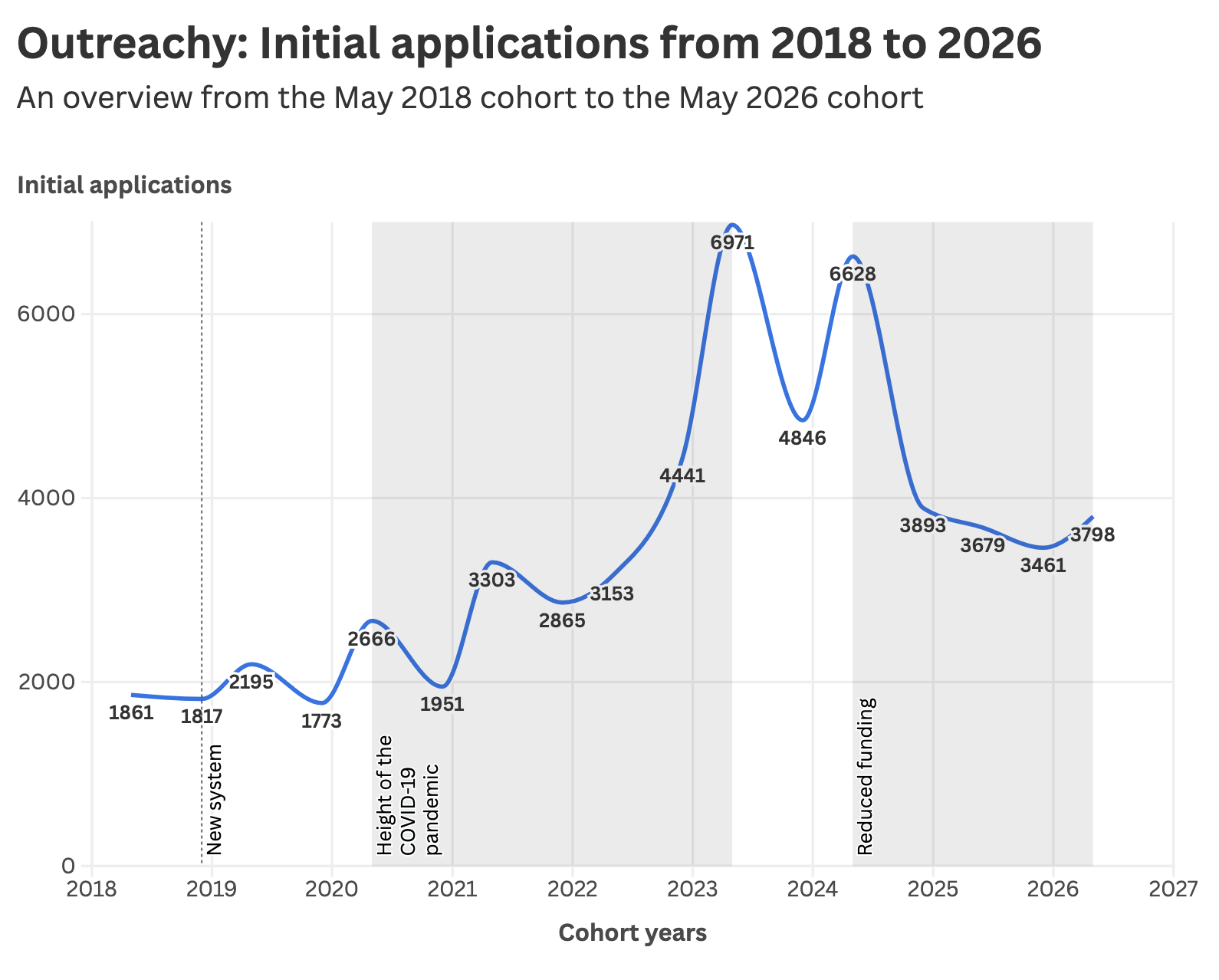
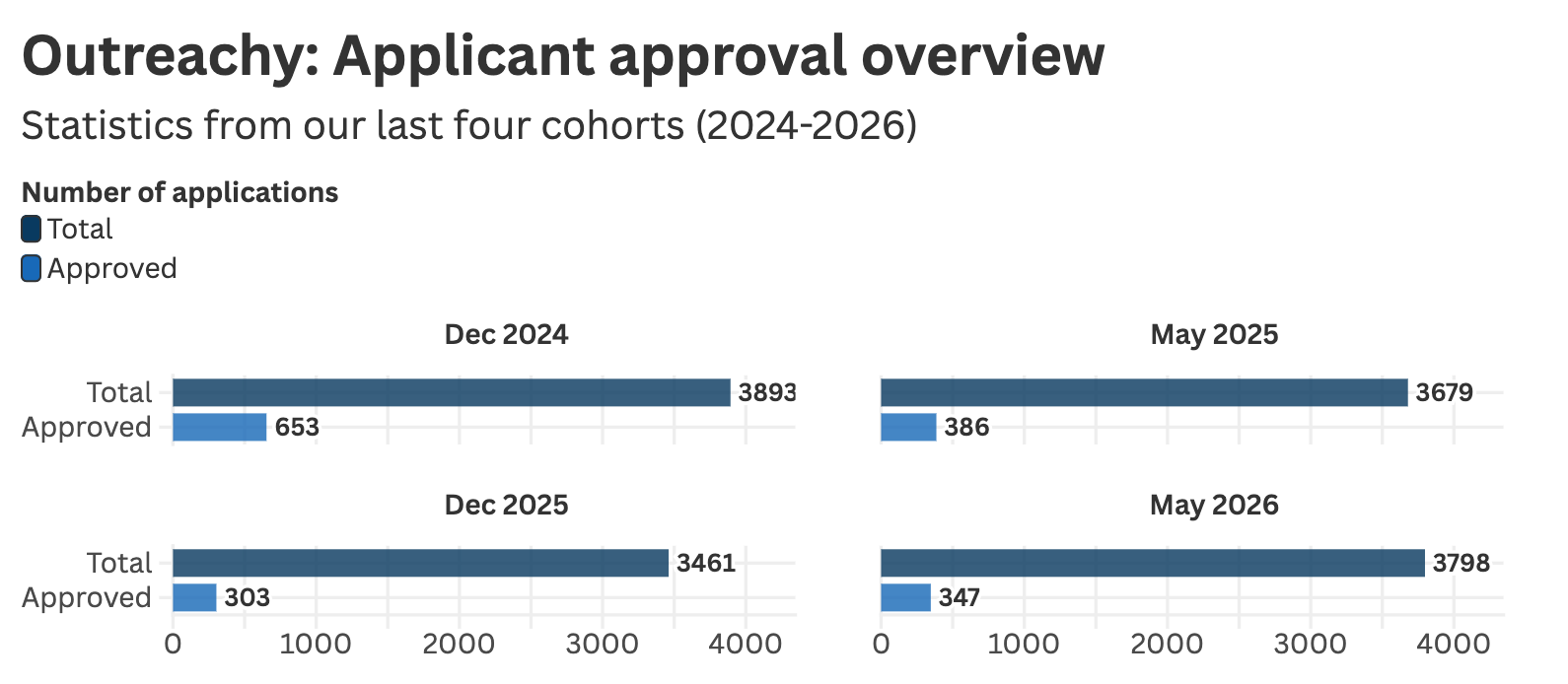
Taking into consideration the last four cohorts of Outreachy, as of July 2026, we receive an average of 3,707 initial applications per cohort. In our December 2024 cohort, we approved 16% of total initial applications. Two years later, our average initial application approval rate decreased to 8 to 10% of total initial applications.
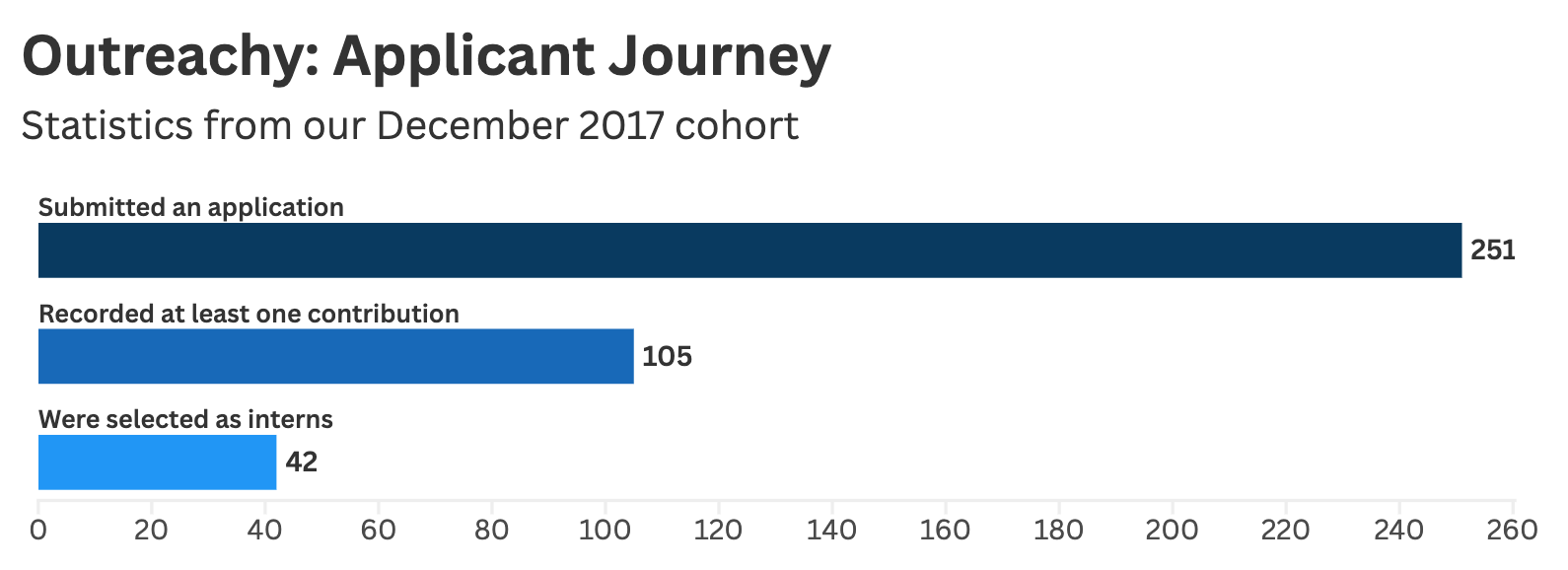
Cohorts prior to 2018 should be compared against numbers from our contribution period onwards. For example, in our December 2017 cohort, we received 251 applications. Such applications should be understood as an expression of interest. 105 applicants contacted mentoring communities, completed starter tasks and recorded at least one contribution. That corresponds to almost 42% of all applicants. Their applications were considered for selection by mentoring communities. Lastly, 42 applicants were selected as interns.
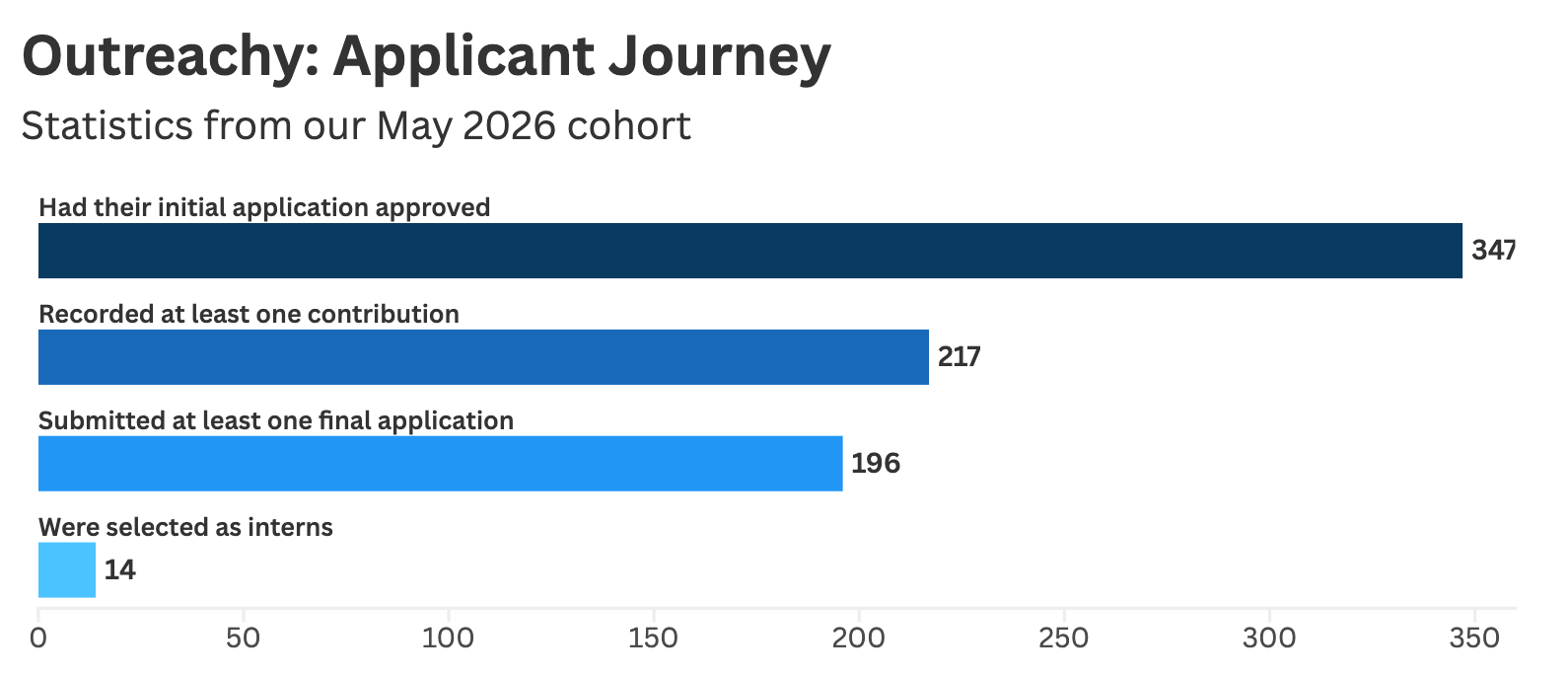
To ensure all applicants engaging with mentoring communities during the contribution period are eligible, we introduced an initial application process in early 2018. To draw a more proportional comparison, let's take a look at numbers from our May 2026 cohort. 347 applicants had their initial application approved, thus were authorized to proceed to the contribution period. 217 applicants recorded at least one contribution — that's 78% of all applicants. To be considered for selection, applicants have to submit a final application. 196 of our applicants submitted a final application. 14 of them were selected as interns.
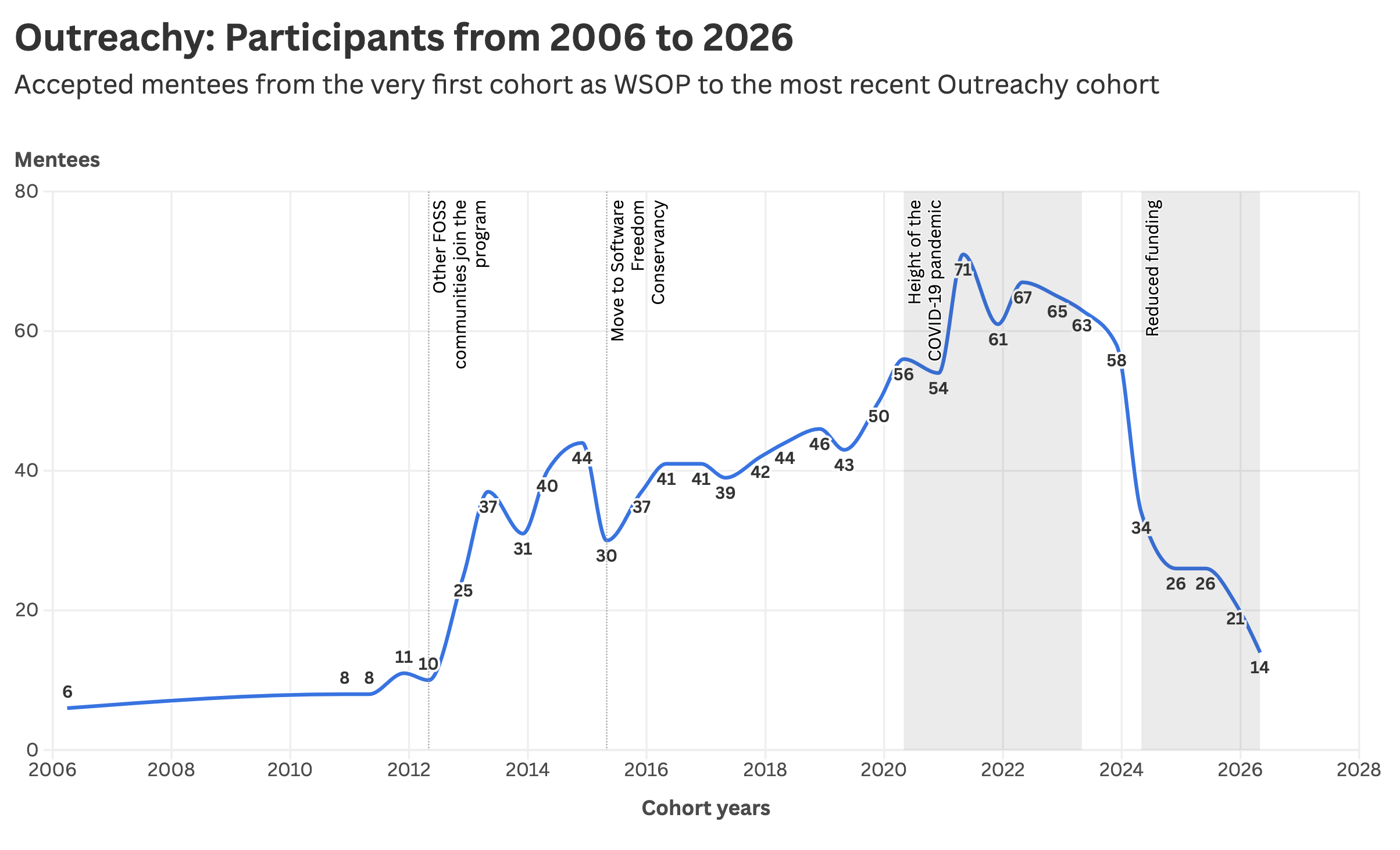
Below is a time series of accepted mentees from the very first cohort in 2006 to our most recent cohort in 2026. The program started with offerings from the GNOME community only. In 2012, GNOME hosted a cohort with the Twisted project and another with 11 FOSS communities. The amount of accepted mentees increased in 50% once other mentoring communities joined, and reached its peak during the height of the COVID-19 pandemic. A period of reduced funding brings the number of accepted mentees to the level of the first years of the program.
We consider an internship successful if:
- The intern receives positive feedback from their mentors in all four cycles of evaluation
- The intern has made significant contributions to their mentoring community or project, which should be documented by commits, pull requests, blog posts and/or presentations
From 2017 to 2026, 98% of our internships were successful. We observed an average of 1 internship termination per cohort. 90% of terminations occurred due to a prolonged period of disengagement or underperformance from mentees even after organizer intervention. 10% occurred due to life circumstances, such as accepting a job offer or illness in the family.
In a longitudinal study conducted in 2019, we uncovered that our alumni are 92% women; 4% transgender, genderqueer, or non-binary people; 64% people of color; and 12% people from a historically disadvantaged caste or tribe. Additionally, 80% of our alumni continued to contribute to open source after their internship ended.
Challenges
Accepting more mentees requires increased funding and mentoring capacity. Accepted mentees are contingent on project offerings, which are contingent on mentoring capacity. Our peak in accepted interns was supported by widening our mentoring community acceptance criteria to include humanitarian and/or open science communities and partially or fully funding their participation.
Funding alone, however, doesn't remediate a decrease in mentoring capacity. We've observed a decrease in mentoring capacity in FOSS communities the last two years, which caused them to either choose to not participate in the program, withdraw their participation or significantly reduce their usual amount of project offerings.
Our current hypothesis: this decrease in mentoring capacity is caused by ongoing layoffs, burn out due to the current political landscape, and a period of adaption to AI systems through the elaboration of AI policies.
The primary expense covered by our program activities fund is personnel: program organizers and program assistants are paid for their work. A reduced interest and/or an active rejection of diversity initiatives in the United States makes fundraising challenging. We chose to reduce program activities in order to preserve it as we navigate this difficult period.
Additionally, we've observed an overall decrease in interest in funding program activities. Sponsors and grantmakers seem to be more interested in funding one-off projects or initiatives that can be carried on on their own.
-
The first iteration of the program took place in 2006 with a round focused on the GNOME desktop environment. Then, we had a 4-year hiatus before hosting a new season in 2010. ↩