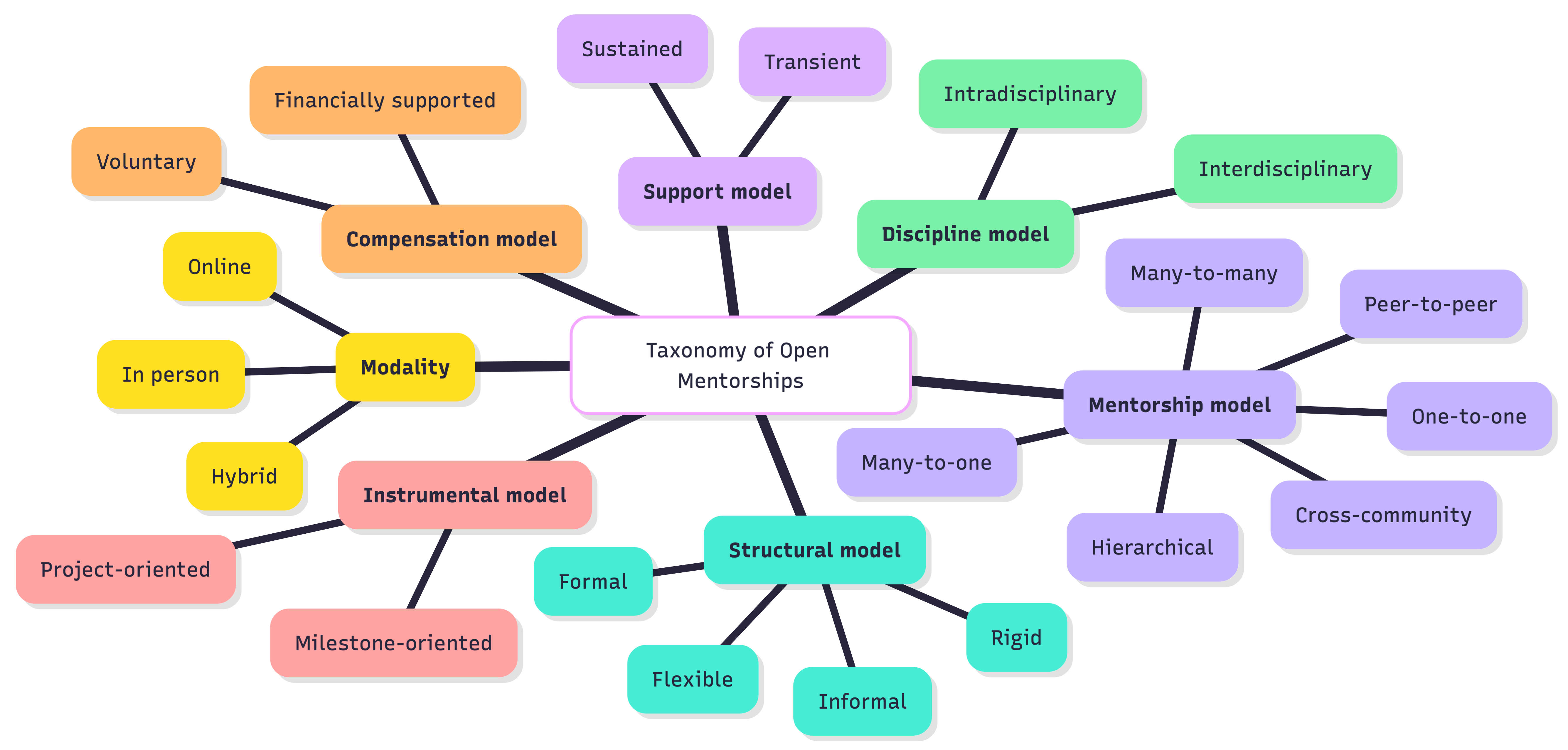
Taxonomy of Open Mentorships
Structural model
Open mentorships may be formal or informal, rigid or flexible.
Formal open mentorship relationships are forged and supported by an organization and/or a program. We can find examples of formal open mentorships in programs such as Outreachy and Google Summer of Code.
Informal open mentorship relationships are not linked to any official or formal structure. They may occur when an experienced contributor chooses to mentor a novice of their own volition.
Rigid open mentorships are expected to follow a pre-defined format and/or timeline. Flexible ones have no pre-defined structure.
Compensation model
We adopt a mentee-centered perspective to classify open mentorships according to their compensation model. Open mentorships may be financially supported or voluntary.
Financially supported open mentorships provide stipends or other forms of financial compensation to mentees. We can find examples of financially supported formal open mentorships in programs such as Outreachy and Google Summer of Code.
Voluntary open mentorships don't provide any form of financial support to mentees. Open mentorships provided by the program Big Open Source Sibling are an example of voluntary open mentorships.
Support model
Open mentorships may be transient or sustained.
Transient open mentorships support mentees for a well-defined, usually short period of time through a transitional development period. This is commonly observed in formal and rigid open mentorships.
Sustained open mentorships support mentees indefinitely or through multiple development phases and are expected to last indefinitely. We often observe this model of open mentorship in informal and flexible open mentorship relationships, but they may also occur in formal and rigid ones.
Discipline model
Open mentorships may be intradisciplinary or interdisciplinary.
Intradisciplinary open mentorships focus on a single discipline. An open mentorship focused on improving a mentee's programming skills is intradisciplinary.
Interdisciplinary open mentorships work across multiple disciplines. Open mentorships striving for personal and professional development in multiple areas is interdisciplinary.
Mentorship model
Open mentorships may be one-to-one, many-to-one or many-to-many. They may also be peer-to-peer, hierarchical, or cross-community.
One-to-one open mentorships are provided by assigning a single mentor to a single mentee. Programs such as rOpenSci Champions provide one-to-one open mentorships.
Many-to-one open mentorships are provided by assigning multiple mentors to a single mentee in a practice we call co-mentoring. Mentors may choose to co-mentor in order to balance the workload of guiding a mentee or to fill the gaps across multiple disciplines or expertises. Outreachy often provides and strongly encourages many-to-one open mentorships.
Many-to-many open mentorships involve one mentor working with multiple mentees simultaneously, or a cohort of mentees who learn partly from each other under shared guidance. Outreachy runs cohorts this way, where interns are placed in programs together and encouraged to support one another. Many-to-many open mentorships scale better than one-to-one relationships and builds community among participants, but they require more coordination and can mean less individual attention.
Peer-to-peer open mentorships puts two people at roughly similar levels of experience guiding each other. This works well in open source communities where the goal is mutual skill building rather than hierarchical knowledge transfer. Peer mentorship tends to feel lower-stakes, which can make it easier for both people to be honest. Its limitation is that neither person may have the experience or perspective to see what the other is missing.
Hierarchical open mentorships are a classic model where a more experienced person guides a less experienced one. This is the structure most FOSS internship programs use, including Outreachy and Google Summer of Code. Its strength is depth: a mentor who has been working in the community for years brings context that a peer simply can't. Its risk is the power imbalance discussed above, which requires active attention.
Cross-community mentorship pairs a mentor and mentee from different open source communities, organizations, or disciplines. This is less common but increasingly valuable as the open source ecosystem becomes more interconnected.
You don't have to choose just one model. Many effective programs combine them: a hierarchical pairing as the core relationship, a cohort structure for peer connection, and occasional cross-community exchanges for breadth.
Instrumental model
Open mentorships may be project-oriented or milestone-oriented.
Project-oriented open mentorships are centered on the development and/or completion of a specific project. This project may be proposed and structured by mentors and/or mentees. Programs such as rOpenSci Champions, Google Summer of Code and Outreachy are project-oriented.
Milestone-oriented programs are centered on the achievement of specific individual mentee milestones. Programs such as Big Open Source Sibling are milestone-oriented.
Modality
Open mentorships may take place exclusively in person, online or in a hybrid mode.
We may see exclusively in person open mentorships in Birds of a Feather events focused on supporting first contributions. Programs such as Google Summer of Code and Outreachy provide exclusively online open mentorships. But we often observe open mentorship relationships develop over a mix of online and in person interactions.