Lifecycle of Open Mentorships
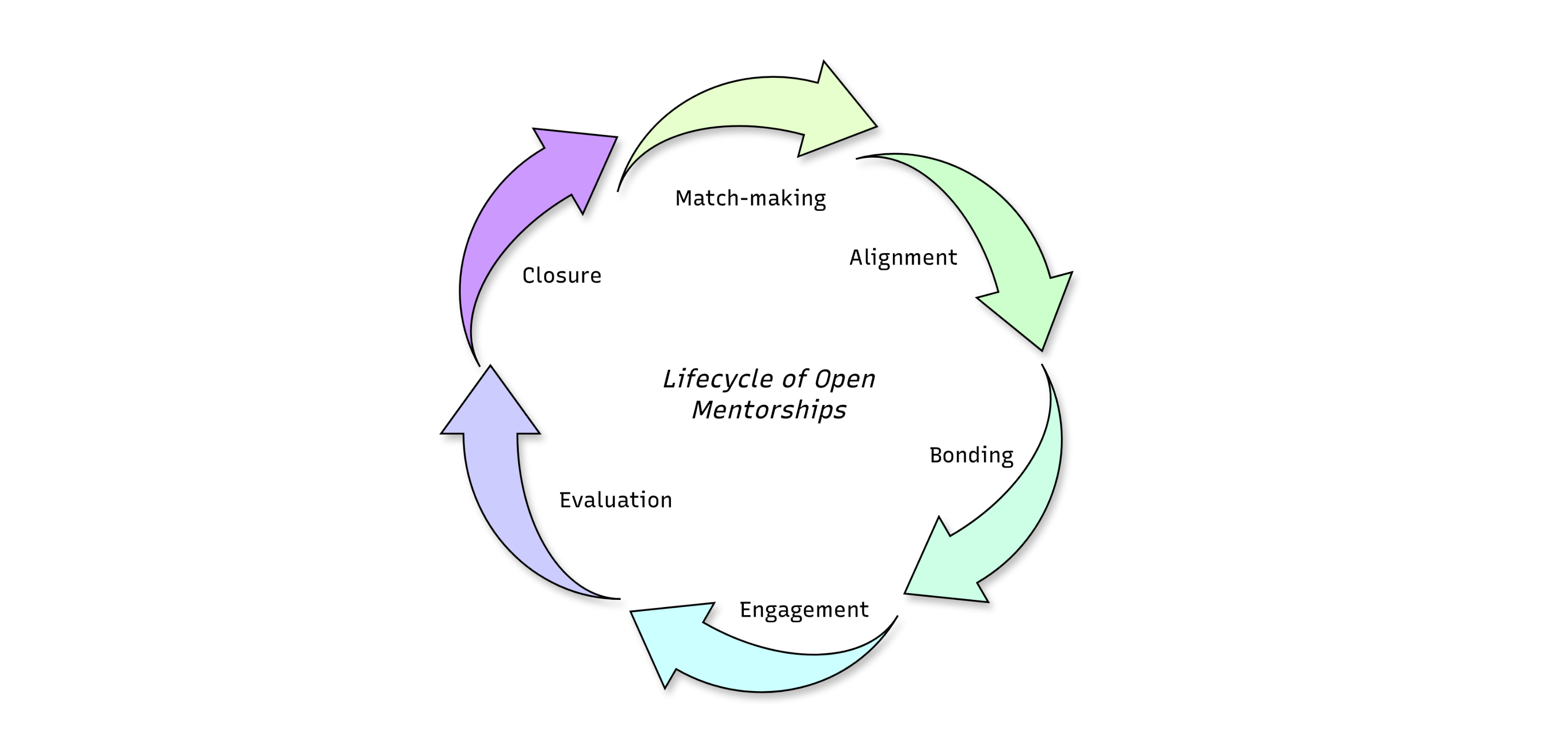
David Clutterbuck proposes five phases in a mentoring relationship: rapport building, direction setting, progress making, winding down, and moving on1. We observe similar stages in open mentorships. We notice, however, different phase combinations depending on the nature of the mentoring relationship, as mentioned on Taxonomy of Open Mentorships.
Match-making
This may occur by matching mentors with mentees or matching mentees with specific challenges.
Mentor and mentee matches are made either through social mechanisms (e.g. recommendations, professional or educational circumstances) or programmatic processes (e.g. applications). Informal and flexible open mentorships are more likely to be formed through social match-making. Formal and rigid mentoring relationships are more likely to be forged under the guidance and facilitation of open mentorship programs.
Mentee and challenge matches may occur in all types of mentoring relationships. Mentors may use outputs from a previous Evaluation stage to present mentees to new opportunities to grow.
Alignment
This phase is similar to Clutterbuck's rapport building and direction setting. Mentors and mentees set expectations for their relationship, establish communication channels, frequency and intensity of contact and supervision. If this is a formal, rigid or transient mentoring relationship, discussing the timeline and expected outputs for this mentoring relationship is a pre-requisite. But if this is an informal, flexible or sustained mentoring relationship, mentors and mentees may frame their first conversations in terms of struggles currently faced and immediate priorities.
Bonding
This phase also takes inspiration from Clutterbuck's rapport building. Mentors and mentees learn more about each other's perceptions, communication styles, levels of expertise. Mentees are encouraged to immerse themselves in the specific context their work will then flourish by networking with key facilitators, reading relevant documents, and/or experimenting with tools and environments of work. Then, mentees are expected to have a clearer perspective on upcoming tasks and activities. Mentors are expected to connect mentees with all resources required to build a foundation to complete such tasks and activities.
Engagement
This phase mirrors Clutterbuck's progress making. Mentees go through cycles of microphases of orientation (i.e. gathering instructions for tasks they'll complete), development (i.e. applying what they've learned from the bonding period and the orientation microphase) and feedback (i.e. adjusting development artifacts according to immediate reviews from their mentors).
The engagement stage ends once a mentee achieves milestones set during the Alignment phase. Milestones may be output-based or time-based. The latter is often adopted by open mentorship programs with transient mentorships.
Evaluation
This phase has a similar mission to Clutterbuck's winding down stage. Once a milestone is achieved, mentors and mentees take a step back to evaluate their progress and their relationship to determine whether they should continue their mentoring relationship. Open mentorship programs may step in during this phase by structuring evaluation cycles through feedback forms, and organizers of programs such as Outreachy and Big Open Source Sibling choose to intervene whenever they detect signs of mentor-mentee conflicts.
Closure
Based on feedback collected during the Evaluation phase, mentors and mentees head to a new cycle of their mentoring relationship: they may continue it, end it, or transform it. While somewhat similar to Clutterbuck's moving on stage, we envision this phase to be the last step before a new cycle by admitting the possibility of a continuation of an open mentorship.
For formal, rigid and transient open mentorships, the continuation of their mentoring relationship is expected if they haven't exhausted the mentorship period (e.g. 3 months, 6 months).
Its termination is encouraged if mentors and mentees aren't a good match, which may happen due to circumstances such as work or communication styles, time conflicts, or expertise mismatch — and it's left to program organizers to decide if they'll rematch mentors and mentees or terminate the mentorship period in its entirety.
A transformation of mentoring relationships may occur in open mentorships of any nature, in several different circumstances: changes to personal or professional commitments, an increase in independence, confidence and skill level from the mentee, new challenges or priorities.
-
National Institute for Health and Care Research. “Phases of the Mentoring Relationship.” NIHR.ac.uk, 2021, www.nihr.ac.uk/phases-mentoring-relationship. ↩