Considerations Before Becoming an Organizer
Welcome to the organizer learning path! If you're here, you have a systemic view of open projects and you want to promote change within this ecosystem at a bigger scale. But before we talk about the intricacies of organizing a program, we need to have a conversation about your motivations and the ecosystem as a whole.
Why should you have a systemic view of open projects?
We believe that employing conventional thinking principles don't create resilient open mentorship programs. We, systems practitioners, start our journey by learning about something called General Systems Theory. General Systems Theory states that:
“Systems are a set of elements dynamically interrelated to perform activities aiming at achieving a specific goal, while consuming energy, materials or data (input) and producing new forms of energy, materials or data (output).” — L.V. Bertalanffy. General System Theory: Foundations, Development, Applications as cited by V. V. G. Neto, R. Araujo, R. P. dos Santos on New Challenges in the Social Web: Towards Systems-of-Information Systems Ecosystems.
This is the paradigm that is the guiding principle of systems thinking:
“Rather than reducing an entity to the properties of its parts or elements, systems theory focuses on the arrangement of and relations between the parts which connect them into a whole.” — F. Heylighen, C. Joslyn. What is Systems Theory?
In other words, systems thinking sees the bigger picture. The General Systems Theory — and, by extension, the academic definition of systems thinking — is proposed in opposition to what some authors may call reductionist thinking or conventional thinking.
Conventional thinking reduces a complex world to its parts. It assumes our world is stable, predictable, and objective. On the other hand, systems thinking embraces how the world is uncertain, unstable, and experienced and understood from multiple worldviews.
I don’t want to give you the impression that conventional thinking isn’t useful — it can be! But human life is complex, and so are the things we build and the situations surrounding them. In fact, to some authors, the latter can be called messes.
In a continuum, you’ll find difficulty on one end and mess on the other. Difficulty would be the equivalent of a simpler problem and mess, of a complex situation. Some authors say we can solve simpler problems, but we manage complex situations. We cope with them1. Why is that?
Messes have more serious implications, multiple actors involved, intertwined and independent aspects and factors in different guises, and it often happens over a longer time-scale. But most importantly, messes are hard to pin down. They’re hard to conceptualize.
Conventional thinking isn’t that great to cope with messes2. Why?
- We may ignore interconnections when we don’t look at the bigger picture
- We may assume the problem has a single cause instead of understanding that multiple intertwined factors may lead to that situation
- We may assume a single person is to blame instead of understanding how the situation that led to a problematic outcome came to be
- We may hyperfocus on an outcome — something we can measure — rather than on processes by which we can achieve beneficial change3
If you're considering organizing a program, you're probably thinking about how to cope with a mess. You know that's not a temporary situation — otherwise, creating and managing a project would suffice. You understand that remediating that situation is a complex process that requires continuous and arduous work.
How do you create a model of a mess?
As a potential organizer, your first mission is creating a model of the mess you want to address:
“In dealing with a problematic situation, a decision maker must develop a concept—a representation or a model—of it. They attempt to solve the problem as they conceive it. Thus if their conception is wrong, the solution to the problem as conceived may not solve the problem as it exists.” — Adapted from Russell L. Ackoff in The Art of Problem Solving
We start with a question or a problem. A problem arises through conflict or disconnection between the current state of things ("as is") and their idealized state ("to be"). Then we think about who faces that problem, why and how. They will be the people your program will serve.
Maybe you want to address a recurrent gap in education and training. For example, your vision for the future of research may be research that's open by design, but you may have noticed that universities don't train researchers on open science practices — they are forced to figure it out on their own. Or maybe you noticed that the path to contribution or leadership in your community isn't accessible to everyone, and you want to create a safe path and space for new contributors or leaders to grow and thrive. Maybe it's difficult to find a mentor to help them in this journey, and you want to connect mentors and mentees.
In every problem there are things we can and cannot control. Maybe you can't change the way multiple teams process new contributions, but you've found allies in two teams that can help you test strategies to make the contribution flow more accessible. Maybe you don't have the influence to change research publishing policies in universities, but you can plant the seeds of change by offering a training program.
We also have constraints — things that limit what we can do about the problem. Maybe every organizer have to volunteer their time because you don't have funding to pay them for their work, and that limits how much time each one of them can invest in the program.
Analyzing those aspects of a problem may lead us to possible outcomes. We may find optimal and/or satisfactory solutions. An optimal solution is the best, most effective solution to a problem. A satisfactory solution is one said to be "good enough".
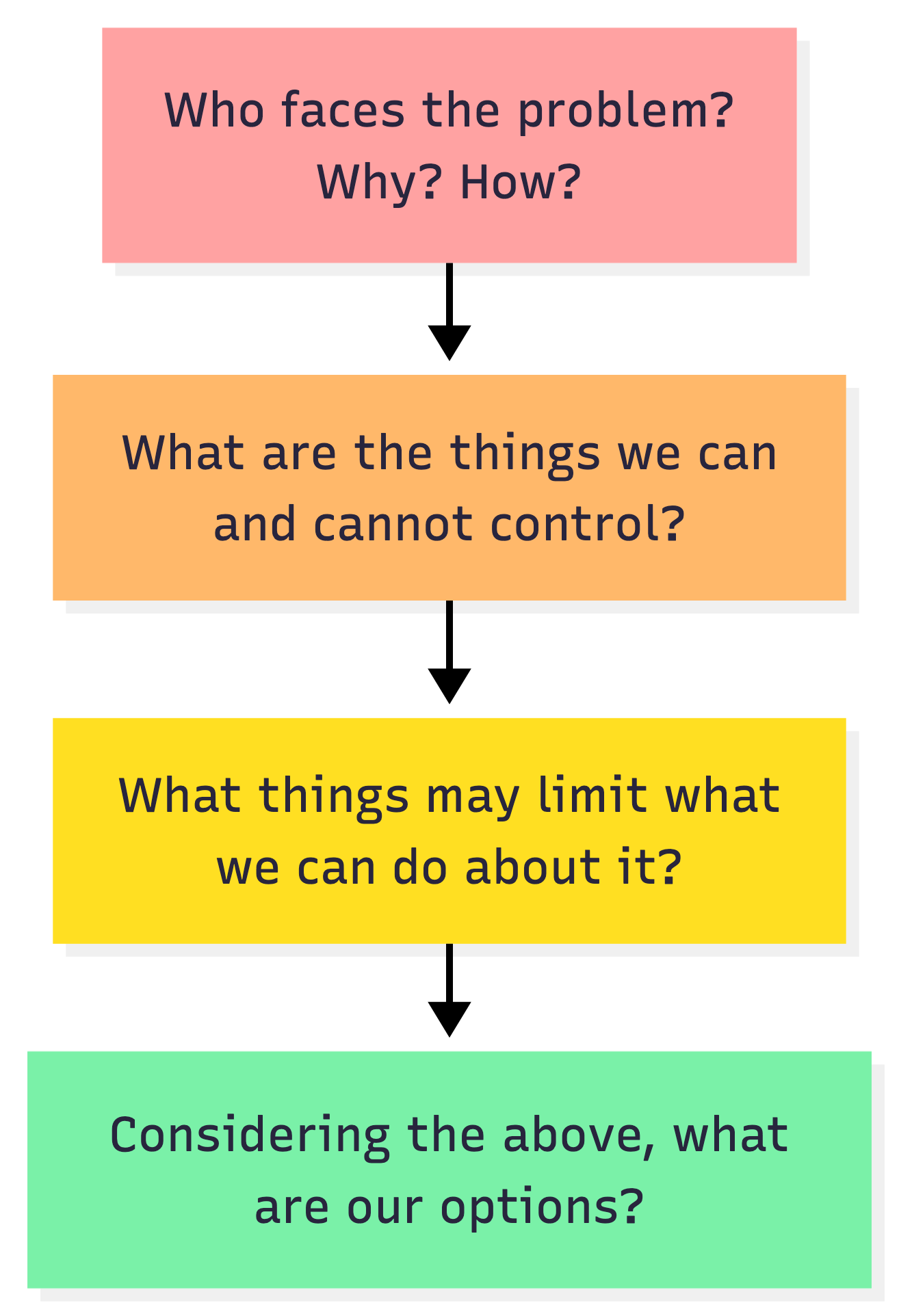
Problem solving framework4
Think of your model as a temporary representation of a problem rather than a definitive one — your understanding of a problematic situation will evolve the more you're involved with it. In fact, we recommend that you revisit this model from time to time to check what still rings true and what doesn't. If your problematic situation is better addressed through initiatives that empower the professional and personal development of others, then we recommend that you should consider organizing an open mentorship program.
Should you join existing efforts or create a new initiative?
We recommend that you study similar initiatives in the same field or similar communities. What do they have in common? What makes them stand out from the rest? Is there anything you would change about them to help you address the problem you want to solve, or are they perfectly adequate to achieve that goal? If any of the existing initiatives you've studied are aligned with your vision for an open mentorship program, we advise you to approach their organizing teams and join forces. The creation of a new initiative requires a lot of investment and energy.
If existing efforts don't address issues of your concern or are designed with diverging strategies, we recommend that you create a new program. Outreachy was created to address a gender gap observed in Google Summer of Code. Big Open Source Sibling was born from the experiences of a professor with extreme programming and the desire to make open source more accessible to Brazilians from minoritized groups.
What do you need before joining or creating a program?
We advise you to have a sponsor in your community or field to join an existing effort or kickstart a new initiative. This sponsor isn't necessarily an organization or people providing financial support, but it should be an organization or people actively supporting your efforts to join or create an open mentorship program.
We recommend you understand the taxonomy of open mentorships and hold discussions in your community about what kind of open mentorships is most compatible with existing community structures and dynamics.
We encourage you to read and talk to other communities and program organizers about their experiences with open mentorships. Our resources for program organizers is a great place to start!
In the next chapter
We'll talk about how to design an open mentorship program!
-
Martin Reynolds and Sue Holwell in Introducing Systems Approaches, “Messes and Difficulties” (p. 5-6) (2020) ↩
-
Martin Reynolds and Sue Holwell in Introducing Systems Approaches, “Traps in Conventional Thinking” (p. 6-7) (2020) ↩
-
Measurement is important — it ensures the continuation and improvement of open mentorship programs. A hyperfocus on specific metrics, however, may take away your attention from what provoked you into creating a program to serve your community. ↩
-
Based on Russell L. Ackoff. (1978). The Art of Problem Solving: Accompanied by Ackoff’s Fables. Wiley, 1987. ↩