Your Journey as a Mentor
You decided to become a mentor and picked a model of open mentorship that fits you best — what happens next? We expect both formal and informal open mentorship opportunities to follow the same lifecycle:
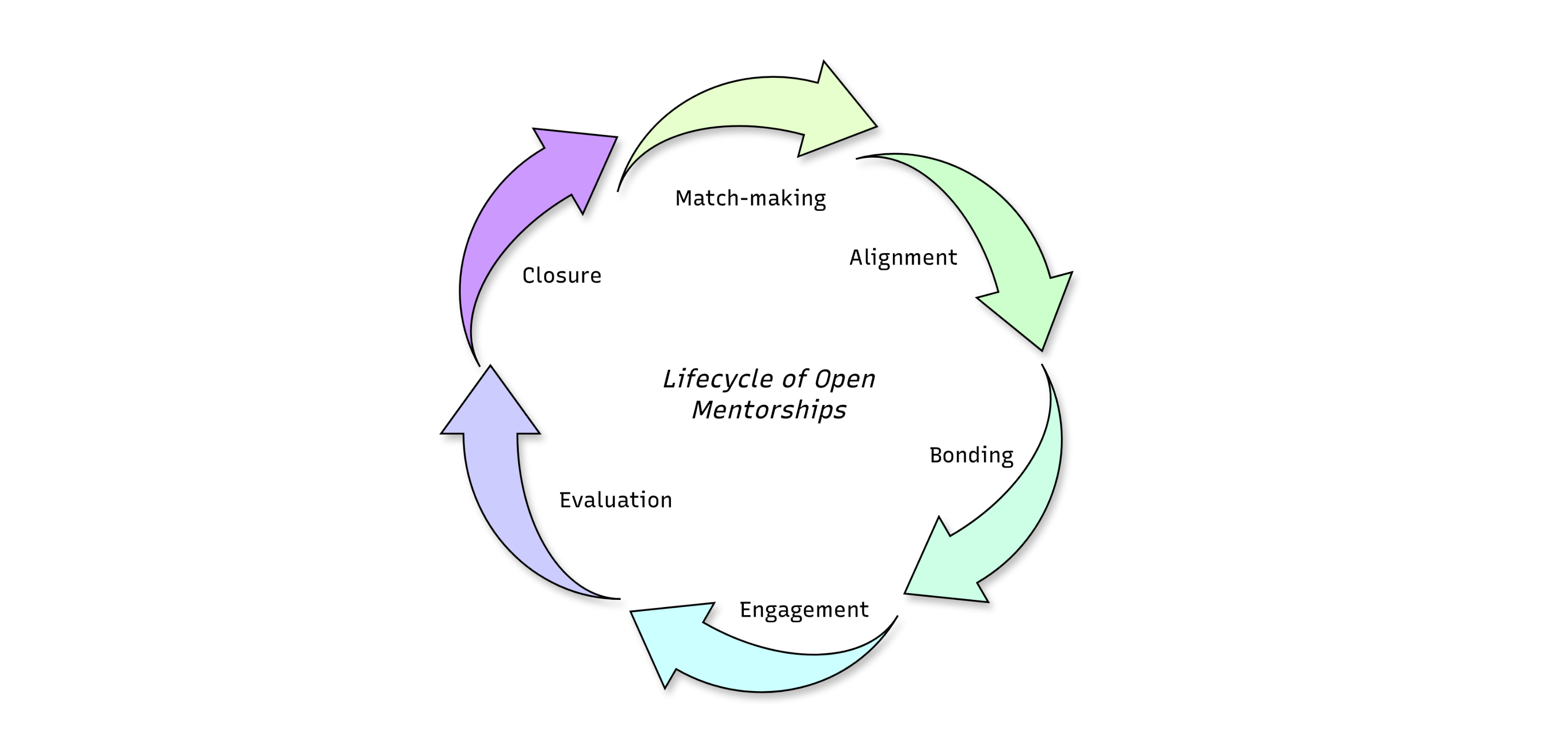
Match-making
Match-making is the process that forges open mentorship relationships. For a formal open mentorship, that process is completed once you've selected a mentee or has been matched with one. For informal open mentorships, it's fulfilled once you found a mentee to work with.
If an open mentorship program allows mentees to apply to several projects and they're selected for all of them, organizers (1) may contact all mentors and ask them if they have another strong candidate to select (2) may contact the mentee and ask which project they prefer.
Once you have a match, we expect open mentorship programs to contact you and your mentee and inform you about:
- Who was selected to be your mentee and special instructions, if any1
- Synchronous and asynchronous communication channels
- Your expected open mentorship schedule and actions (e.g. evaluation cycles)
- Bureaucratic steps such as signing mentor agreements
Alignment
Alignment is the phase that helps both you and your mentee set expectations for your open mentorship relationship. You may discuss topics such as creating a timeline of events, establishing communication channels and frequency, deadlines, deliverables and evaluation criteria. Additionally, you may talk about your mentee's current struggles and priorities and plans. You should leave this stage with an action plan and aligned expectations for your open mentorship experience.
In a formal open mentorship relationship, your mentee may ask you if you would like to start the alignment phase before its official start date. Whether you should do it or not depends on individual factors:
- Can you already commit some time to have several conversations about expectations?
- Does your community or team need some time to prepare to onboard your mentee? Do you need time?
We advise our mentors to wait for the start date. The week or weeks before the start of an open mentorship may help both you and your mentee to recover from the intensity of later stages of the selection process and to make any adjustments to your routine or environment in preparation for the upcoming months of collaborative work.
How long alignment discussions will take depends on the complexity of planned tasks and activities, mentor and mentee availability, and chosen means of contact and communication. We recommend that mentors and mentees have at least one asynchronous communication channel and one or more periods of synchronous communication via text and voice or video. We observe that frequent one-to-one synchronous communications help mentors and mentees bond faster and fully.
When learning about your mentee's current struggles, ask them for an example of a task or situation where their struggle made them think they couldn't overcome that barrier. Breakdown that task or situation into smaller parts to create a plan to help them overcome it. For example, if they're nervous about public speaking but wish to present a talk at a technical conference one day, try to understand what about public speaking makes them nervous. Is it about knowing what to say at the right time or facing an audience? Is it about not feeling confident enough in their technical capacity?
An action plan for this struggle may include synchronous one-to-one sessions where your mentee explains to you a technical topic they've learned that week. Another step may be having them present their current work in written form on your community's or team's blog, or on a social media platform like LinkedIn. Or maybe they can participate in smaller technical sessions within your community and build their confidence with smaller audiences.
Learning about your mentee's priorities and plans is another important factor in building a successful mentorship relationship. You may find some mentees to be more assertive and resolved about future plans than others. If a mentee doesn't have immediate plans or is struggling to visualize a path to take, it may be useful to have a session with them to discuss different their possibilities.
We recommend that you frame paths as possible choices, not as recommendations — only your mentee can determine if a potential path is desirable and feasible. If you notice an interest in a specific path, but your mentee shows signs of low self-confidence, we encourage you to connect your mentee with friends or colleagues that have taken that path. Meeting role models may help them see themselves taking that path as well.
Be mindful of cultural differences as you get to know your mentee. Different cultures may have different expectations about communication styles or how to build a successful career. The nature and the availability of career-building opportunities may also be different across different countries.
For example, a mentor may consider attending university an important stepping stone for a successful career, but a mentee may not consider pursuing a Bachelor's degree due to varying life circumstances (e.g. cost, time commitments, geographical location, educational background) or choice. On the other hand, mechanisms to access higher education may not be what you expect — while undergraduate degrees may be associated with a high acquisition cost and/or student loans in some countries, other countries may offer facilitated access or free education to nationals and foreigners.
Checklist: Aligning expectations
- My mentee and I discussed my mentorship style and their learning style
- My mentee and I discussed my feedback style and evaluation criteria
- I established one asynchronous communication channel with my mentee
- I scheduled at least one or more synchronous one-to-one communication sessions with my mentee
- I learned about my mentee's current struggles
- I learned about my mentee's priorities and plans
- My mentee and I have discussed and established our mentorship goals
- I have a plan to help my mentee with their current struggles
- My mentee and I discussed and established our deliverables and deadlines
Template: Action plan
# Action plan
- **Mentorship period:** [DATE] to [DATE]
- **Mentorship goals:**
    -
    -
    -
- **Timeline:**
  - Bonding period: [DATE] to [DATE]
  - Development: [DATE] to [DATE]
    - Deliverable 1:
        - Description:
        - Requirements:
        - Deadline: [DATE]
    - Deliverable 2:
        - Description:
        - Requirements:
        - Deadline: [DATE]
    - Evaluation: [DATE] to [DATE]
Bonding
Bonding is the phase where both mentees and mentors learn (1) foundational concepts, standards, policies and processes (2) how to closely work together. We expect them to leave this stage with a better understanding of their project and/or community and capable to develop solutions or assignments.
We recommend that mentees keep notes about everything they're learning so they can reference them later and bring questions to meetings or communication channels with their mentors. We recommend encouraging your mentee to make those notes public and picking a place to also create collaborative notes with your mentee.
Publishing discovery notes may help your mentee build their confidence to share their work with a larger audience and help you follow their progress (and intervene whenever needed). Writing collaborative notes is a way to consolidate knowledge and experiences between you and your mentee, and it gives them the opportunity to teach you new things about your shared domain as much as you will teach them.
Plan this phase to build your mentee's capacity for more complex tasks later in the mentorship. This is an opportunity to get accustomed to cycles of orientation (i.e. gathering instructions for tasks they'll complete), development (i.e. applying what they've learned) and feedback (i.e. adjusting deliverables according to immediate reviews).
Tip
Keep in mind that learning can be a non-linear process, and that what you perceive as easy or difficult may not be what your mentee see as easy or difficult.
The first weeks of an open mentorship may be extremely overwhelming for your mentee. We ask mentees to look for their mentor's help if they've been stuck on a task for 2 to 3 hours, and we recommend mentors to be proactive if they notice their mentee struggling to complete a task and struggling to communicate it.
Remember, your mentee is still working on fully trusting you. They may struggle to show you what they perceive as a vulnerability. We observed that sharing anecdotes about your own struggles — past or current — helps mentees feel more comfortable and confident in sharing theirs.
Engagement
Engagement is the phase of active open mentorship work. You'll go through microphases of orientation, development and feedback with your mentee. We expect them to leave this stage with a set of completed deliverables or achievements.
In the engagement phase, we observe mentees becoming more confident: they can explain technical concepts with ease and find solutions to issues they face independently.
On the other hand, this phase tests the resilience and compatibility of open mentorship relationships. It may expose differences in communication styles that you may have dismissed during the bonding phase, and/or it may show you that your mentee isn't as engaged with their open mentorship as they should.
We advise mentors to not wait for an evaluation cycle to make interventions in an open mentorship. Mentors should to set aside some time to have conversations about the structure of the open mentorship itself and the performance of their mentees during this phase. It's best for you and for your mentee if you raise any issues as they're small rather than letting them escalate to a proportion you can no longer contain or address on your own.
However, as organizers of an open mentorship program, we do understand that some situations may be beyond your control or your capacity. Some programs may offer office hours for mentors to discuss ongoing issues and/or accept requests for one-to-one meetings with organizers. Organizers may enact interventions upon a mentor's request.
Evaluation
Evaluation is the phase where mentors and mentees evaluate their progress. In open mentorship programs, you may be asked to evaluate your mentees's performance. Sometimes, mentees may be asked to evaluate your performance too. Some programs may condition stipend payments to a successful mentor evaluation and/or receive requests for extensions, assistance or terminations during this period.
We ask mentors to provide as much detail as possible about their mentee's progress. In a financially supported open mentorship, a detailed progress report helps organizers submit adequate documentation to process payment authorizations. Details may include an overview of the mentee's work and links to public artifacts of the open mentorship such as pull requests, commits or blog posts.
In this phase, you may have to contemplate whether you should ask for an extension, organizer intervention or a termination. Programs may offer extensions as a way to help open mentorships recover from a period of inactivity caused by a mentee's life circumstances (e.g. sickness, natural disasters, political events). Interventions may be needed if a mentor doesn't know how to move forward with the open mentorship or wishes to hear an outside perspective. A termination may be warranted if all other options were exhausted or a serious incident, such as a code of conduct violation, has been reported and confirmed.
If you're in an informal open mentorship relationship, you and your mentee may have to figure out what's the best way to evaluate your relationship and your progress. The template below may help you with that conversation!
Template: Evaluation
# Evaluation
**Date:** [DATE]
## Progress report
- My mentee completed...
- My mentee finished...
- My mentee learned...
## Proudest achievements
- ACHIEVEMENT 1
- ACHIEVEMENT 2
## Points of concern
- CONCERN 1
- CONCERN 2
## Current struggles
- STRUGGLE 1
- STRUGGLE 2
Closure
For formal and informal open mentorships, Closure may signify the end of your current open mentorship experience and an opportunity to transform your relationship with your mentee. You may choose to keep in contact, having occasional meetings and still working together; you may become their colleague, or you may choose to part ways. We recommend at least keeping some sort of communication channel open (e.g. connecting on LinkedIn, asking for a personal email address, following each other on social media platforms).
For informal open mentorships, Closure can be the end of your current mentorship cycle and the start of a new one. You may go through another phase of match-making, alignment, bonding, engagement, evaluation and closure. A new match-making cycle may mean matching your mentee with a new challenge rather than a new mentor.
Template: Closure reflection
# Closure
**Date:** [DATE]
- **What are your proudest achievements of this mentorship cycle?**
- **What would you change about your mentorship experience?**
- **What wouldn't you change about your mentorship experience?**
- **What advice you have for those looking for an open mentorship opportunity?**
-
Special instructions may include start dates that deviate from standard dates and accommodation requests. Some open mentorship programs may be open to set custom start and end dates to attend to a mentee's needs (e.g. going through medical procedures, finishing university exams, moving to a new country). ↩