Communicating with Mentors and Organizers and Talking About Your Work

Effective communication is the key ingredient for an enjoyable and safe open mentorship experience. In our years managing open mentorships, we've observed several internship terminations caused by communication breakdowns raised too late for repair because mentors and mentees had lost their trust in each other. This chapter includes everything we wish our mentees to know about communicating in an open mentorship context.
Mentor-mentee communications
Communication channels
We expect mentors and mentees to communicate both synchronously (i.e. in real time, like in a voice chat) and asynchronously (i.e. not in real time, like in an email exchange happening over the course of a few days). We encourage mentor-mentee pairs to use both communication modes as both of them have their strengths and weaknesses:
- Synchronous communication allows for real-time debugging and problem-solving, and encourages rapport building activities (e.g. conversing about matters other than tasks or projects at hand). However, it may be difficult to use synchronous communication modes such as voice or video calls frequently in unstable or low bandwidth connections — so adding written communication channels helps mentees and mentors in this situation.
- Asynchronous communication gives everyone time to craft a more detailed and thought out response. Longer response times may also motivate mentors and mentees to write clearer messages to each other. On the other hand, it's difficult to convey tone through written communication. Some of our mentees have reported that they feel asynchronous communication is "colder" than synchronous means; adding occasional voice or video chats may help mentors and mentees bond more.
Here are some questions you can ask your mentor: - What are your preferred communication channels? - When and how often can we meet for a video or voice chat? - What's your availability during the week? How should I proceed if I ran into an issue and you're not available? - How long do you expect to take to reply to messages or emails? - Is there anyone else I can talk to if I can't reach you?
Daily notes as a form of communication
An Outreachy mentor-mentee pair with a 4-hour timezone difference used daily notes as a way to encourage asynchronous conversations. The mentee published notes about their progress and learnings at the end of every work session, and their mentor read them the day after they were published. This gave the mentee enough space to grow more confident and independent while providing the mentor a non-intrusive way to monitor their progress.
Communication styles
Mentors and mentees from different cultural backgrounds may have different communication styles. Sometimes, their communication styles clash — a mentor who's used to being succinct in their writing may cause a mentee to catastrophize and think they're not doing a good job. That's one of the reasons why (1) Outreachy has a contribution stage (2) we ask mentors and mentees to have a conversation about work and feedback styles during the Alignment phase before the Bonding period.
The contribution phase acts like a trial period for both mentors and mentees, immersing each other in a simulation of what working together may look like. That simulation, however, has its limits; some situations may not be contemplated by interactions while completing introductory tasks. We hope to remediate such pitfalls by encouraging active conversations about expectations during the Alignment phase and having a dedicated Bonding period.
Preparing for meetings
We advise you to keep shared meeting notes with your mentor. Prepare an agenda before any synchronous meetings: ask your mentor whether they want to discuss any particular topics with you and add your own. You can pick agenda items based on priorities, questions you've had throughout the week or struggles you're currently facing. Be ready to walk your mentor through your thought process — and don't be surprised if this prior exercise leads you to the answer you were looking for.
Whenever a discussion results in an action item — something you or your mentor need to act on —, add it to a list at the top of your meeting notes. That will help you and your mentor (1) check if there's anything you need to do in the next week or so (2) check if there's any pending tasks before your next meeting.
Use the notes section to take note of any important information shared during the meeting — for example, if your mentor mentions a blog post about debugging an issue you're facing, add a link to that blog post and a brief description to your notes section.
Tip
Don't wait for an evaluation cycle to tell your mentor that you're struggling with something — tell them as soon as you realize you're stuck. We advise mentees to spend 2-3 hours trying to solve an issue before asking for help. Don't forget to tell them everything you've tried!
Template: Meeting notes
Date: [DATE]
Attendees: [NAMES]

## Action items
- [ ]
- [ ]
- [ ]

## Agenda items
- TOPIC 1
- TOPIC 2
- TOPIC 3

## Notes
-
-
-
Communicating with organizers
Communication channels
Some programs may be more proactive in keeping communication channels with mentees outside feedback forms. For example, Outreachy and Big Open Source Sibling use asynchronous (email) and synchronous communication (Zulip, Telegram, voice and video chats) channels to keep in touch with their mentees. Other programs may offer feedback forms and email as the only forms of communication due to their scale.
When should I raise an issue with organizers?
We advise mentees to not wait for evaluation cycles to raise issues about their open mentorship experience — the sooner we hear about it, the better the outcome may be. Here are a couple of situations that may require mentee-organizer communication or intervention:
- Personal issues (e.g. sickness, death in family)
- Natural catastrophes (e.g. earthquakes, heatwaves)
- Job or scholarship offers that may interfere with current time commitments
- Absent mentors (e.g. missing meetings, ignoring messages, not reviewing deliverables)
- Conflicting work styles or expectations
What do organizers do when a mentee or a mentor raises an issue with them?
It depends on program policies. Some programs may allow for extensions to accommodate absences of any or specific nature, or meet with separately with mentees and mentors to understand the situation and propose an intervention plan. Other programs may pause and terminate an open mentorship experience if it shows signs of failure. We encourage you to familiarize yourself with program policies to know what to expect.
Open communication
We call open communication the practice of openly documenting and sharing your work with others, one of the foundational principles of open projects and communities. Open communication ensures an open project, community or ecosystem can continue your work or create derivatives from it. You can use mix of ephemeral and long-lasting media to document and share your work:
- Talks
- Videos
- Papers
- Reports
- Interviews
- Blog posts
- Social media posts
What does documenting your work mean? It means writing about the context, motivations and reasoning behind your proposals, decisions and deliverables. It means talking about the process behind the scenes to define a problem and conceptualize a solution. And to do so, you need to learn storytelling.
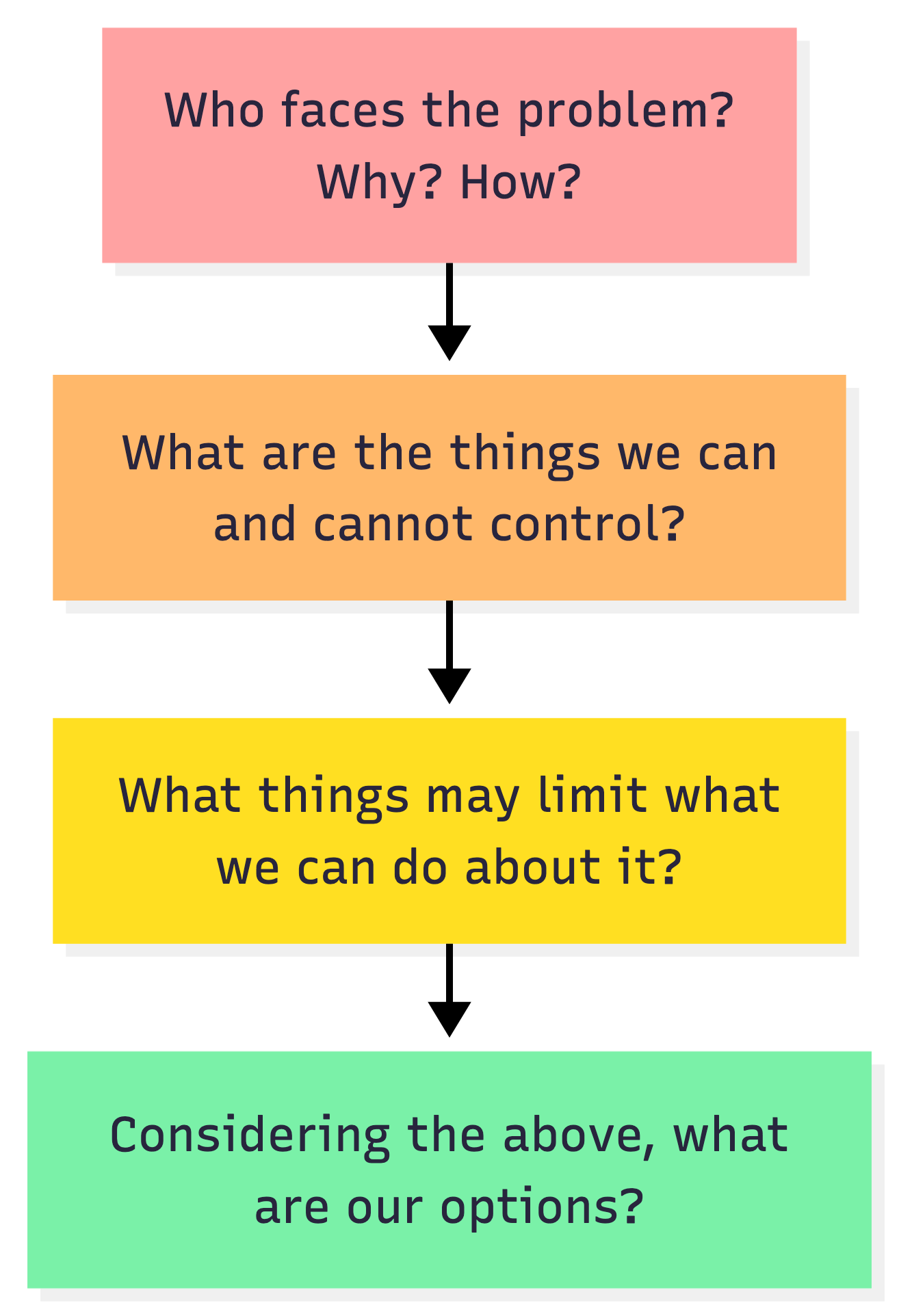
Problem solving framework1
We start with a question or a problem. A problem arises through conflict or disconnection between the current state of things ("as is") and their idealized state ("to be"). That could be, for example, the perception that a project's visual identity is outdated, or the absence of a desired feature. Then we think about who faces that problem, why and how. For an outdated visual identity problem, it may be that their current logo can't be easily reproduced in textiles or not appropriate for digital platforms. For a desired feature, a specific group of users may want access to granular settings to produce a particular outcome.
In every problem there are things we can and cannot control. We can control the color palette we may use to create a logo redesign, but people may use several different devices to view it — some are color calibrated, some aren't. We can control what programming design patterns we'll use to improve a software's performance, but we can't quite predict the performance of that software in every hardware combination.
We also have constraints — things that limit what we can do about the problem. Maybe there's a hard deadline for submitting a logo redesign, and that means we can't conduct as many interviews as we wish to determine the level of acceptance to that design. Or maybe certain parameters are actually defined by a third-party library, and you can't do much to change the way they integrate into a software.
Analyzing those aspects of a problem may lead us to possible outcomes. We may find optimal and/or satisfactory solutions. An optimal solution is the best, most effective solution to a problem. A satisfactory solution is one said to be "good enough".
“In dealing with a problematic situation, a decision maker must develop a concept—a representation or a model—of it. They attempt to solve the problem as they conceive it. Thus if their conception is wrong, the solution to the problem as conceived may not solve the problem as it exists.” — Adapted from Russell L. Ackoff in The Art of Problem Solving
It's important to present your work through this framework of thinking because it communicates (1) your understanding of the context (2) the effectiveness of your solution and, therefore, (3) what could possibly be done to improve it, evolve it or apply it to different contexts.
In the next chapter
- Next steps after your open mentorship experience!
-
Based on Russell L. Ackoff. (1978). The Art of Problem Solving: Accompanied by Ackoff’s Fables. Wiley, 1987. ↩