Your Journey as a Mentee
You were selected as a mentee or found a mentor to work with — what should happen now? We expect open mentorship programs to contact you and inform you about:
- Your start and end date
- Any immediate action items:
- Signing an agreement or contract
- Joining communication channels
- Filling out tax forms
- Providing payment information
- Scheduling a call with your mentor
- Evaluation expectations (dates, forms, outputs)
We expect both formal and informal open mentorship opportunities to follow the same lifecycle:
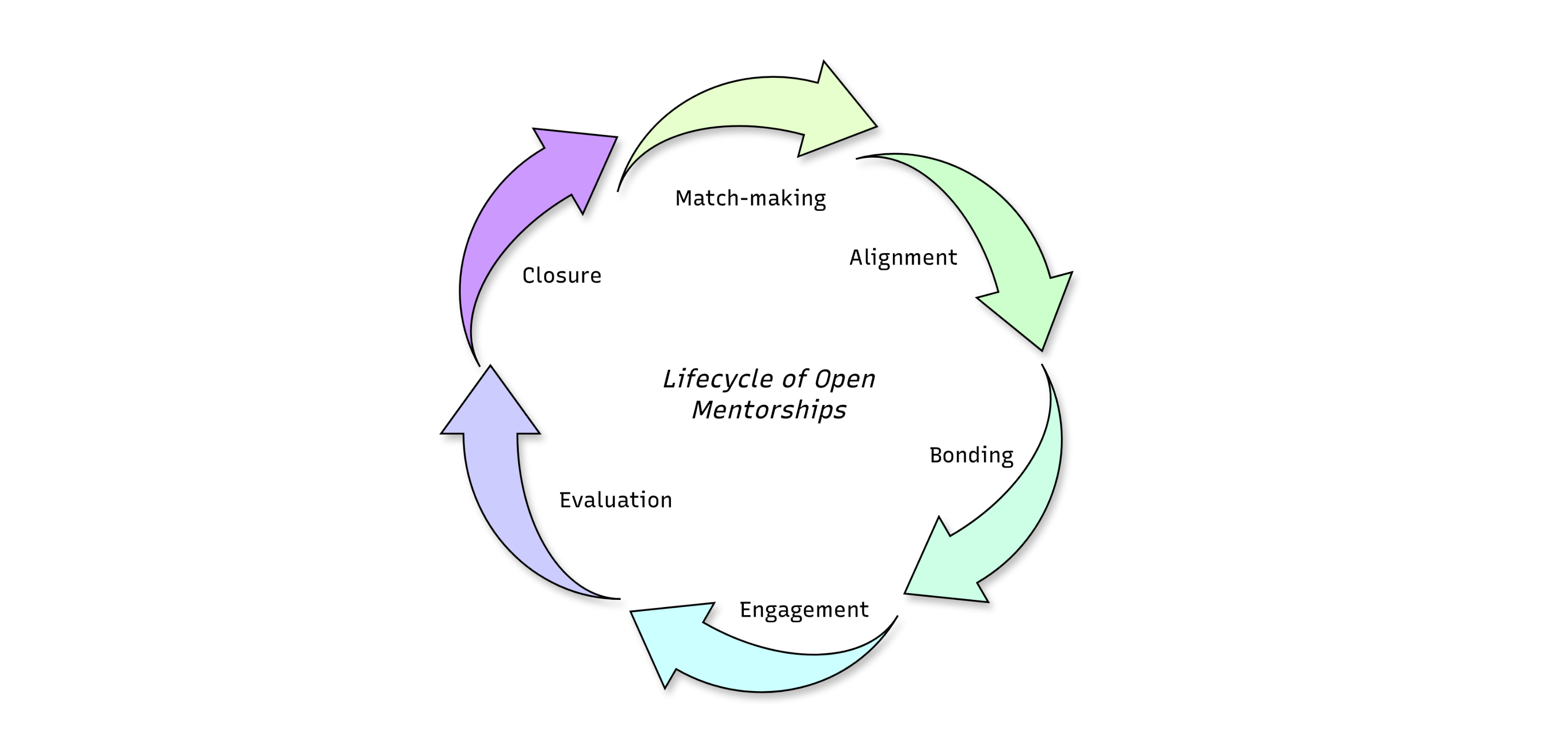
Match-making
Match-making is the process that forges open mentorship relationships. For a formal open mentorship, that process is completed once you've been selected as a mentee. For informal open mentorships, it's fulfilled once you found a good mentor to work with.
If a program allows you to apply to several projects and you're selected for all of them, organizers (1) may contact mentors and ask them if they have another strong candidate to select (2) may contact you and ask which project you prefer.
Alignment
Alignment is the phase that helps both you and your mentor set expectations for your open mentorship. You may discuss topics such as creating a timeline of events, establishing communication channels and frequency, deadlines, deliverables and evaluation criteria. Additionally, you may talk about your current struggles and immediate priorities. You should leave this stage with an action plan and aligned expectations for your open mentorship experience.
Template: Action plan
# Action plan
- **Mentorship period:** [DATE] to [DATE]
- **Mentorship goals:**
    -
    -
    -
- **Timeline:**
  - Bonding period: [DATE] to [DATE]
  - Development: [DATE] to [DATE]
    - Deliverable 1:
        - Description:
        - Requirements:
        - Deadline: [DATE]
    - Deliverable 2:
        - Description:
        - Requirements:
        - Deadline: [DATE]
    - Evaluation: [DATE] to [DATE]
Bonding
Bonding is the phase where both mentees and mentors learn (1) foundational concepts, standards, policies and processes (2) how to closely work together. We recommend that you keep notes about everything you're learning so you can reference them later and bring questions to meetings or communication channels with your mentors. You should leave this stage with a better understanding of your project and/or community and capable to develop solutions or assignments.
Template: Discovery notes
Date: [DATE]

## Today I learned
- TOPIC 1
- TOPIC 2
- TOPIC 3

## Questions
- QUESTION 1
- QUESTION 2
- QUESTION 3
Engagement
Engagement is the phase of active open mentorship work. You'll go through microphases of orientation (i.e. gathering instructions for tasks you'll complete), development (i.e. applying what you've learned from the bonding period and the orientation microphase) and feedback (i.e. adjusting deliverables according to immediate reviews from your mentors). You should leave this stage with a set of completed deliverables or achievements.
Evaluation
Evaluation is the phase where mentors and mentees evaluate their progress. In open mentorship programs, you may be asked to evaluate your mentor's performance and your own. Some programs may condition stipend payments to a successful mentor evaluation or receive requests for extensions, help or terminations during this period.
We ask you to always submit feedback about your mentor or the program. Evaluation channels are closely monitored by program organizers. Some programs such as Outreachy intervene in mentor-mentee relationships if they detect conflicts or compatibility issues in feedback submissions. But know that evaluation channels aren't the only way to raise an issue about your open mentorship experience — don't hesitate to contact program organizers at any time if needed.
If you're in an informal open mentorship relationship, you and your mentor may have to figure out what's the best way to evaluate your relationship and your progress. The template below may help you with that conversation!
Template: Evaluation
# Evaluation
**Date:** [DATE]
## Progress report
- I completed...
- I finished...
- I learned...
## Proudest achievements
- ACHIEVEMENT 1
- ACHIEVEMENT 2
## Points of concern
- CONCERN 1
- CONCERN 2
## Current struggles
- STRUGGLE 1
- STRUGGLE 2
Closure
For formal and informal open mentorships, Closure may signify the end of your current open mentorship experience and an opportunity to transform your relationship with your mentor. You may choose to keep in contact, having occasional meetings and still working together; you may become their colleague, or you may choose to part ways. We recommend at least keeping some sort of communication channel open (e.g. connecting on LinkedIn, asking for a personal email address, following each other on social media platforms).
For informal open mentorships, Closure can be the end of your current mentorship cycle and the start of a new one. You may go through another phase of match-making, alignment, bonding, engagement, evaluation and closure. A new match-making cycle may mean matching you with a new challenge rather than a new mentor.
Template: Closure reflection
# Closure
**Date:** [DATE]
- **What are your proudest achievements of this mentorship cycle?**
- **What would you change about your mentorship experience?**
- **What wouldn't you change about your mentorship experience?**
- **What advice you have for those looking for an open mentorship opportunity?**
In the next chapter
- Learn how to communicate effectively with your mentor and program organizers
- Learn how to promote your work as a mentee